

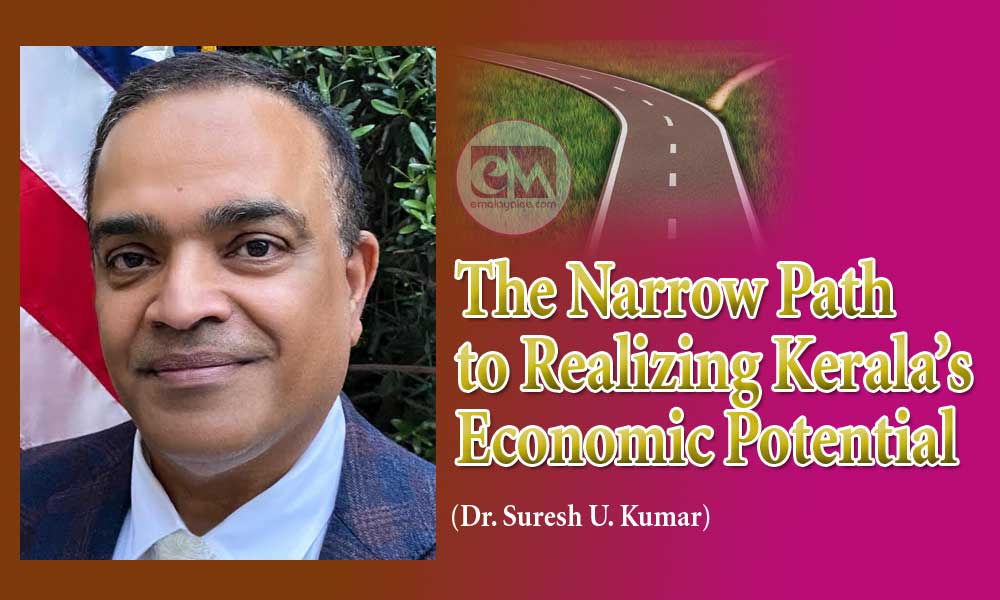
The Narrow Path to Realizing Kerala’s Economic Potential (Dr. Suresh U. Kumar)
Kerala’s greatest export has never been spices, cashew, or coir. It has been her own children.
At the Kochi airport, a little after midnight, you can watch the future of Kerala board a plane and leave. A young woman from Kollam, the first in her family to finish nursing college, hugs her mother one last time and walks toward security with two suitcases and a job offer from a Gulf hospital. Multiply her by two million, and you have the central fact of Kerala’s economy for the last fifty years. I know those departure lounges well; I walked through one in 1991, bound for a job in New York.
We should be honest about what exporting our people has brought. The money Keralites send home, about 2.17 lakh crore rupees in 2023, is nearly a quarter of the State’s economy. It built houses, helped educate generations of young families, and created a consumption economy that kept the State afloat. Yet because of that easy money and weak political will, Kerala fell behind her southern neighbours, and the culture of enterprise, once the defining trait the people of Kerala were known for, went missing. That is why I, and millions like me, had to leave.
Yet Kerala also gave us the foundational skills for success. My own first venture in America survived its darkest winter, after the dot-com crash and September 11, because a handful of friends, some Malayalees, none related to me, put their trust in my idea. I have spent my life grateful for that trust and wondering why we so rarely extend it to a young founder at home.
Here is the uncomfortable arithmetic. Kerala has the most educated young people in India and cannot employ them. Youth unemployment is near 30 percent, and for young women closer to 47. So they leave — as workers to the Middle East and other Indian cities, and as students bound for London, Toronto, and Melbourne. Meanwhile the Gulf model that carried the state for decades is quietly fading; the number of nurses cleared to work abroad has fallen by roughly a third in just three years. The State’s finances are stretched, salaries, pensions, and interest consuming nearly 70 percent of revenue, and Kerala is ageing faster than any other Indian state. The clock is ticking.
The instinct is to ask which large corporation or factory we might persuade to hire our graduates. Kerala should play that game too, but it is an uphill battle. Land and and labour are costly, the States infrastructure strained, and coastline fragile. The almost annual floods and the Wayanad landslide have taught us the limits of what our ecology can bear.
The answer is not just to import jobs. It is to also grow them at home. Entrepreneurship-led development, done right, can create thousands of startups, the best of which will scale and employ many.
I have argued this for fifteen years, and the world has only strengthened the case. Set aside Silicon Valley as an outlier and let’s look a few cities similar to Kochi. In India Pune leveraged its universities into a startup hub and Coimbatore reinvented an ageing textile-and-foundry economy around new manufacturing technology. In Europe, Tallinn built its whole economy on digital government and gave the world Skype; Barcelona converted design and mobile technology into an innovation identity. In the US, Kansas City made backing entrepreneurs a permanent civic habit; and San Diego built a bridge from its university labs to real companies. Notably, None tried to become Silicon Valley. Each simply built, patiently, the ecosystem in which local startups could grow.
Kerala can do the same, and faster than the skeptics believe, because it already has what money cannot buy: a good startup base and deep human talent. That startup base was recently ranked among India’s best performers, and the deep-water ports of Kochi and Vizhinjam are now operational. It has an estimated five million Keralites working outside the state who are not merely a source of remittances but a standing network of mentors, investors, and connectors, if only we would organize them with intention. And as of May 2026, Kerala has elected a reform-minded, straight-talking Chief Minister, Mr. V. D. Satheesan, with one of the largest mandates in the State’s history. (In full disclosure, I have known Mr. Satheesan since the mid-1980s, when we both were involved with the Kerala Students Union at Sacred Heart College, Kochi.) The convergence of these forces gives Kerala a rare and narrow opening.
So let me offer a few concrete suggestions.
First, design a sustainable, long-term strategy to grow resilient startup ecosystems, one that is a flat ntwork and formalizes the role of non-partisan “connectors,” the few who have worked across silos and can help founders move fast. It must be connected with existing structures, well-funded, data-driven, and backed by government, universities, business, the diaspora community, and founders alike. Establish a Kerala Innovation Foundation, independent of any party, to build the ecosystems that support new ventures and founders from schools and universities to incubators, from local to diaspora businesses, from non-profits to foundations, with one goal: to make innovation and entrepreneurship a way of life in Kerala.
Second, invite the non-resident Keralite community to be a full partner, not just investors but advisors, mentors, and customers. The diaspora’s real gifts are ideas, expertise, experience, networks, and leadership, and we have barely asked for any of them. Establish a Kerala Enterprise Fund, with a low entry threshold of about ₹100,000 ($1,000) per person, every rupee matched by the State and private partners, and run by a board of diaspora and Kerala entrepreneurs rather than government officials. Alongside, stand up a Choose Kerala Agency, modelled on bodies like Choose New Jersey, with seasoned professionals in key overseas markets to court diaspora founders, investors, and the global corporations now deciding where to place their next Global Capability Centre.
Third, establish a true Enterprise Fast-Lane, so that registering a company and doing business in the state takes days, not the six months it once took me to do what I completed online in America in a single hour. Truly single-window, online, needing neither accountant nor attorney. Reforms are also needed in the machinery of approvals that surrounds land and business deals. Earlier this year, simply to reclassify one small plot with a forty-year-old building on it, I visited the Kochi collectorate seven times in three months, watching my file painfully crawl from desk to desk within one office. The buyer was a local business that desperately wanted to expand; the stalled sale blocked cash from flowing back into the economy and cost jobs. People will invest in Kerala, but only where the processes are quick and transparent.
My central argument is that Kerala has a narrow path toward an entrepreneurship-led economic revival. The new Chief Minister has demonstrated the vision and the right instincts and is backed by the people’s mandate for change. Kerala has the vision and the institutions; what it needs is conviction, connection, convergence, and bold action. The old Gulf model is ending on its own. The assets for a new economy — the ports, the startup base, the global diaspora, the talent, and a rare political opening — are in place at the very moment the demographic clock ticks toward an older and costlier Kerala. If the State retains, trains and converts its human talent into new venture warriors at home over the next ten years, it can build an economy that is worthy of her people. If not, Kerala risks spending the next decade managing a graceful decline — exporting her young and living on their remittances until even those run dry.
Inheritance is what a place hands to us. A future is what we build. Kerala handed her children a magnificent inheritance of education, health, and ambition, and then watched them go and build their futures on someone else’s shore. To build a future worthy of our talented youth, Kerala must change that story. The most powerful case I can make is the one I first made fifteen years ago and believe more firmly today. Among all the paths to sustained and shared prosperity, widespread entrepreneurship is the surest way to ensure that the fruits of freedom, democracy, and economic growth reach the many and not merely the few.
I left for America thirty-five years ago, but the success I found there, and the failures I learned from, rested on the values I absorbed growing up in Kerala: in the schools and colleges, football fields, temple grounds, backwaters, and, I must confess, in its toddy shops. My son is fifteen now, and I would like him one day to return to a Kerala where the talented no longer have to leave to reach their dreams. My secret hope is that the world will one day speak of this revival as the Kerala Dream.
Note: Dr. Suresh U. Kumar is an US based serial entrepreneur, professor, and a member of the New Jersey–India Commission. He is the author of the 2025 Amazon bestseller The Girl in Scarlet Hijab, a work of historical fiction set in Kochi. This article is drawn from a 30-page report submitted to the Office of the Chief Minister of Kerala, Mr. V. D. Satheesan.

EMalayalee Available in MediaAppUSA



Copyright © 2024 emalayalee.com - All Rights Reserved.
Webmastered by MIPL, Web Hosting Calicut Kerala