

IOCUSA Condemns ‘Purification’ Ritual Following Mallikarjun Kharge’s Haldwani Rally
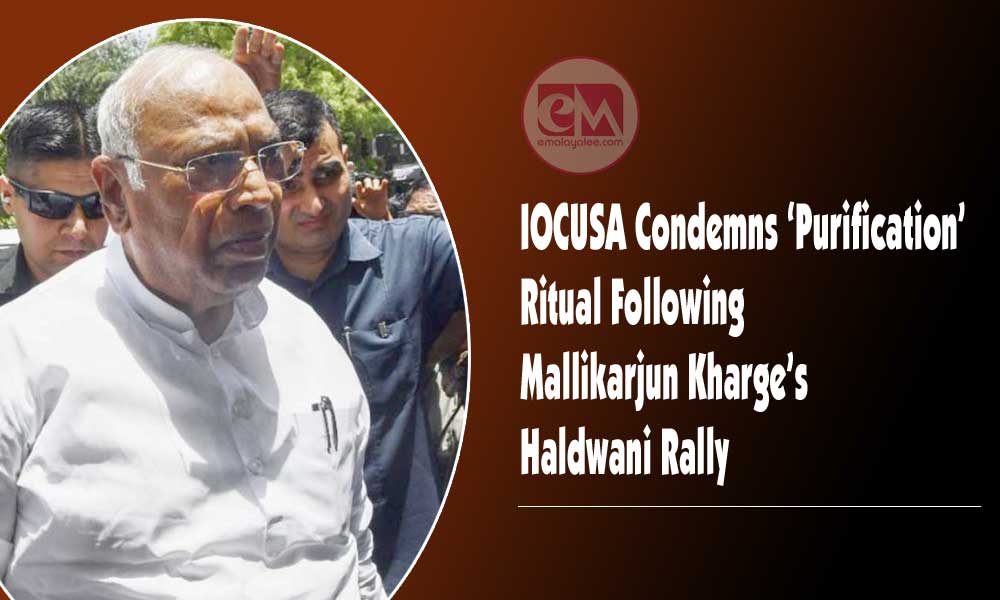
Calls the incident a disturbing manifestation of casteism and a contradiction at the heart of Hindutva politics
New York, August 15, 2026: The Indian Overseas Congress, USA (IOCUSA) strongly condemns the so-called “shuddhikaran,” or purification ritual, reportedly conducted at the Ramlila Ground in Haldwani following a public meeting addressed by Congress President and Leader of the Opposition in the Rajya Sabha, Shri Mallikarjun Kharge.
Whatever explanation may now be offered for the ritual, the symbolism of “purifying” a place after it was occupied by Shri Kharge, a distinguished national leader from the Dalit community, is deeply troubling. Such an act evokes some of the darkest practices of caste discrimination and untouchability that independent India solemnly pledged to consign to history.
There is also a profound contradiction that deserves national attention. On the one hand, the RSS and BJP seek to mobilize Hindus under the broad banner of Hindutva and speak repeatedly about Hindu unity. On the other hand, incidents such as this expose how deeply the remnants of caste hierarchy and a feudal mindset continue to survive within sections of the movement.
“You cannot preach Hindu unity while tolerating a mentality that considers a place somehow contaminated after a Dalit leader has occupied it,” said George Abraham, Vice Chair of IOCUSA. “If everyone is supposedly equal under the Hindutva banner, what exactly required purification after Mallikarjun Kharge left that stage? That is a question the RSS and BJP leadership must answer unequivocally.”
The BJP leadership has denied involvement in the ritual and has said that it does not endorse such practices. We welcome that condemnation, but words alone are insufficient. The authorities must establish who organized the event, what motivated it, and whether individuals connected with political or ideological organizations participated. Those responsible for any act amounting to caste discrimination should be held accountable under the law.
This incident should also serve as a moment of reflection for OBCs, Dalits and other historically marginalized communities who have been increasingly recruited into the Hindutva political movement. They should ask whether genuine social equality accompanies the call for religious unity, and whether they are receiving an equal share of dignity, representation and power rather than merely being mobilized as an electoral constituency.
India’s Constitution offers a radically different vision. Dr. B.R. Ambedkar envisioned a Republic in which citizenship would transcend the hierarchies imposed by birth. Article 17 abolished untouchability because the founders understood that political independence would remain incomplete without social emancipation.
At a time when India celebrates its 80th Independence Day, the country should be moving decisively away from notions of purity and pollution based on caste—not finding new ways to revive their symbolism.
IOCUSA calls upon Prime Minister Narendra Modi, the BJP leadership and the RSS leadership to unequivocally reject caste-based discrimination in word and deed and to ensure that those who invoke the language or symbolism of untouchability find no political or social protection.
“India cannot become a truly developed nation while carrying the chains of caste prejudice into the future,” Abraham added. “There can be no genuine Hindu unity, national unity, or democracy without human equality. The dignity of a Dalit is the dignity of India itself.”
George Abraham
Vice Chair
Indian Overseas Congress, USA (IOCUSA)

EMalayalee Available in MediaAppUSA



Copyright © 2024 emalayalee.com - All Rights Reserved.
Webmastered by MIPL, Web Hosting Calicut Kerala