

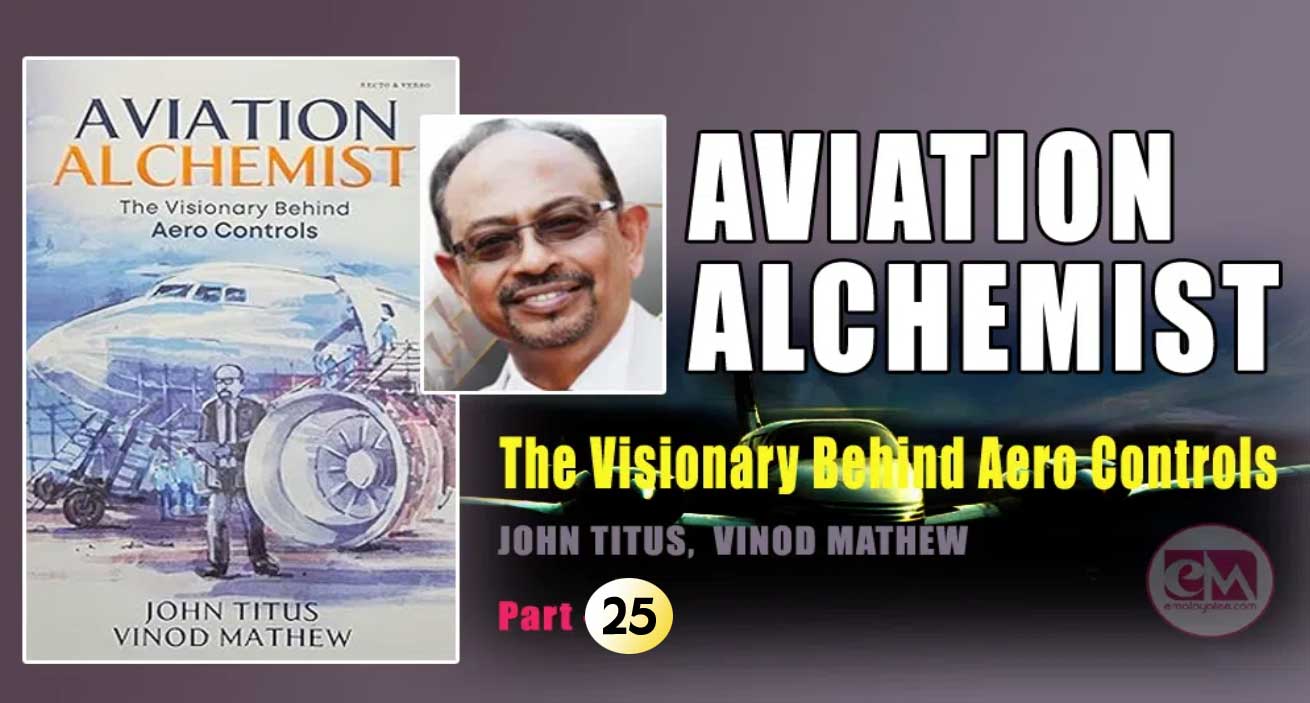
John Titus's Aviation Alchemist -The Visionary Behind Aero Controls (Part -25)
A PATRIOT DISRUPTION
SEPTEMBER 11, 2001, BETTER RECOGNIZED THE WORLD OVER as 9/11, is a day no one will ever forget. Images of terrorist-con-trolled passenger aircraft crashing into the Twin Towers of the World Trade Center in New York will forever remain etched in our minds. These attacks were a body blow for the entire US economy, but it was the aviation industry that had to bear the brunt, for obvious reasons.
The losses the US airline sector suffered in 2001 alone stood at a whopping $8 billion. It continued to bleed for the next five years as many airports across the country turned unprofitable due to the cost incurred by scaled-up security measures. That was the direct fallout of the Aviation and Transportation Security Act which was signed by President Bush in November 2001. It entailed enhanced baggage screening and the deployment of additional security staff for screening passengers among other things.
The impact was so severe that the US aviation sector had to wait till 2006 before it started recording operating profits. Growth became stagnant for almost a decade. Many airlines were merged, giving birth to mega airlines while quite a few regional airlines vanished, simply dropping off the radar.
Yes, international travel did pick after a year or so. But domestic passengers became more circumspect about their need to travel and business houses put a squeeze on work-related travel by getting deals done long distance, there came about a telling drop in the number of aircraft flying the domestic routes. That in turn, meant less repair and maintenance work and a drastic fall in demand for spare parts.
All this could not have come at a worse time for Aero Controls as we had just moved into our new, four-floor building in Auburn, near Seattle. Each floor consisted of 26,000 sq ft, thus aggregating 104,000 sq ft between the four floors. The first and second floors were mostly shops selling parts - they housed hydraulic, mechanical, electrical, electronic, electro-mechanical and life safety equipment shops. The third floor had stock rooms to support sales and shop. The top floor was for offices accounting, purchasing, sales, customer service, IT and of course the top management.
We were hoping for the same growth to continue when 9/11 hap-pened. Aero Controls saw its growth hit a flat line for the next few years. Many startup airlines began struggling. Even legacy carriers were finding the going difficult and were forced to downsize their operations. Aero Controls started looking out for supplementary business options.
In 2007, Ron Bevans, the lawyer we used for the Kazakhstan contract and later in the international arbitration court, approached me with a proposition. An aircraft engine repair shop named
Patriot Aviation Service (PAS) had been declared bankrupt and was available for sale through auction.
Admittedly, the timing could not have been more off as even the existing shop floors were idling in the absence of any business. The flip side was the cost of acquisition would be low, considering the bankruptcy situation.
The main business at Patriot was engine repair, with specializa-tion in jet engines which are quite different from conventional piston engines. Jet engines are internal combustion engines comprising air intake, compressor, diffuser, combustion chamber, turbines and exhaust.
Jet engines are long hollow tubes with various numbers of blades mounted on discs which are attached to the rotor shaft and combustion chamber. All these parts are replaceable either on the wing or in a shop environment. Patriot had nearly 20 employees when it was put on the block.
Some of them worked on the shop floor where engines were disassembled or dismantled before the repair was carried out. Another crew was always ready to travel around the world to repair jet engines on location as the aircraft could not be flown.
To me, it was an entirely different branch of the aviation sector in which I had till then never been involved. In that sense, it was an interesting proposition as such a venture would give me a more complete portfolio of the aviation repair industry. To make the deal more attractive, Patriot had a few engines that were on lease with an airline in Mexico.
It was quite challenging to buy a company that was facing bankruptcy. It would prove to be a whole new ball game as I had never been involved in thus salvaging a company, especially honoring the financial commitments that were sure to follow. There was not
much time to debate the pros and cons at leisure as the Court was about to announce a day they were going to auction off the company.
All interested parties had been invited to participate in the bid by depositing an amount as part of the registration process. We were expecting about four bidders but on that day there was only one other bidder besides us. This bidder had the financial backing of an Arab Sheikh from West Asia. Our internal target was to try to acquire the company below $2 million. But our competitor kept bidding until the quote reached $4 million.
I requested the judge for a 10-minute recess so that we could
reassess the situation and decide it was worth proceeding if our
competitor kept raising the bar beyond $4 million. During the
break, the other party informed the court that they were dropping
off from the race. The judge declared Aero Controls to have won the
bid for Patriot Aviation Service for a consideration of $4 million.
We deposited the amount and the very next day we took over Patriot. We had decided to hire one of the three partners, Virgil, as we thought it would give us an advantage for someone who knew the company to help us take it out of the mess it was in.
One part of our plan was to scale up the engine shop operations. So we moved the Patriot operations from its 10,000 sq ft facility to a newly leased 25,000 sq ft space. I also roped in my son Joby, my CFO Mary Ann, and our lawyers Ron and Virgil as partners, by allotting each one a 5 per cent stake in the newly constituted Patriot management.
It took me a couple of years to find out that Virgil was not an honest person as he had no intention of steering the business out of troubled waters. On the contrary, he was trying to run it to the ground, evidently in the hope that he could take over the business once we were forced to abandon it.
I kept at it for five long years, but Virgil, with his negative attitude, forced my hand. I gave up trying to turn around Patriot after that as I kept coming across many inappropriate transactions. It was becoming increasingly clear that trying to run this business from Seattle as an absentee partner was a near-impossible task.
In 2012, we transferred the business to a group from Miami called Sunbelt. They were not in a position to pay me upfront but agreed to take over the business, get it managed professionally and eventually make it profitable and sell.
For some inexplicable reason, and against my outright warnings, they too decided to keep Virgil at the helm and run the business. Over the next couple of years, under Sunbelt leadership and the management control of Virgil, Patriot went down the drain.
A South American airline, one of Patriot's many clients, filed a complaint about an engine which was certified by PAS but was found short on its performance guarantee. Investigations revealed that the engine had come to PAS first, but Virgil and the team decided to send it out to another shop to get the work done. Nevertheless, the performance certificate was issued by Patriot.
Sunbelt sued Virgil who settled for a sizable amount out of court. Sunbelt too decided it had enough of Virgil. Since they had not paid me any money, I had a lien on the entire business portfolio of Patriot, equipment and all its assets. They transferred everything back to me.
My big challenge thereon was not only to find a buyer for the Patriot but also to find a solution to the outstanding lease on 25,000 sq ft shop space for another two years which was guaranteed by Aero Controls. The lease alone cost me $30,000.00 per month.
Then there were the salaries.
The only person who showed any interest in buying out the company assets was Virgil. He was willing to pay $500,000.00 for the repair shop certificate and tools. I had been contacted by a few employees who saw Virgil and his buddies taking tools and loading them in trucks. The tools we handed over to Sunbelt were no longer at the site. It was very clear to me that tools were stolen by Virgil.
During our initial engagement with Sunbelt in 2012, we formed a company to buy jet engines from the market. They were to be overhauled or repaired and sold for a profit.
This company was named PTJO (Patriot Titus Joint Opportu-nity). As per the plan, Patriot was to find engines which needed repairs. I was to raise funds for the purchase of those engines, while Patriot would undertake the repair. When these engines were sold, both parties would recover their cost first and then split the profit.
Under this plan for PTJO, we bought two jet engines which needed to undergo repair. When all assets were turned over to me, I became the owner of these two engines. These were certified by PAS and were signed off by Virgil. However, both engines failed inspection and testing.
Virgil agreed to fix these engines at no additional labor cost. Since these engines were already certified, I did not expect to spend much money. Pretty soon, Virgil started finding many things wrong with these engines.
We managed to fix one engine and sold it for a neat profit. But the second engine which I thought was in better shape than the first one, was having all kinds of problems.
After two years of constant repair, the second engine was repaired and certified. By that time, the engine price had dropped steeply, from $800,000 to $400,000.00. In addition, Virgil sent me a bill for $400,000.00.
He had only paid me $200,000.00 on the initial sale of Patriot against $500,000.00. He had agreed to pay the balance upon getting the certification from the FAA. Once he received his certification,
he claimed it was inadequate for him to continue running the engine repair shop.
In 2016, I decided to file a case against Virgil and his company. After a long process, in 2018, we settled for a small amount of money. After many years of battle, my Patriot headache was over, but it had cost me a bomb.
I had learned a few valuable lessons. That it does not make sense to make bed with someone with dubious integrity. Also, it is in double jeopardy when the bed itself is in a bad shape.
Sure, the going was tough for the aviation sector in the 9/11 aftermath, but I had made it even more difficult with my Patriot experiment. This was perhaps the only occasion when I got it completely wrong in my core business, which is the aviation sector.
Read More: https://www.emalayalee.com/writer/313

EMalayalee Available in MediaAppUSA



Copyright © 2024 emalayalee.com - All Rights Reserved.
Webmastered by MIPL, Web Hosting Calicut Kerala