

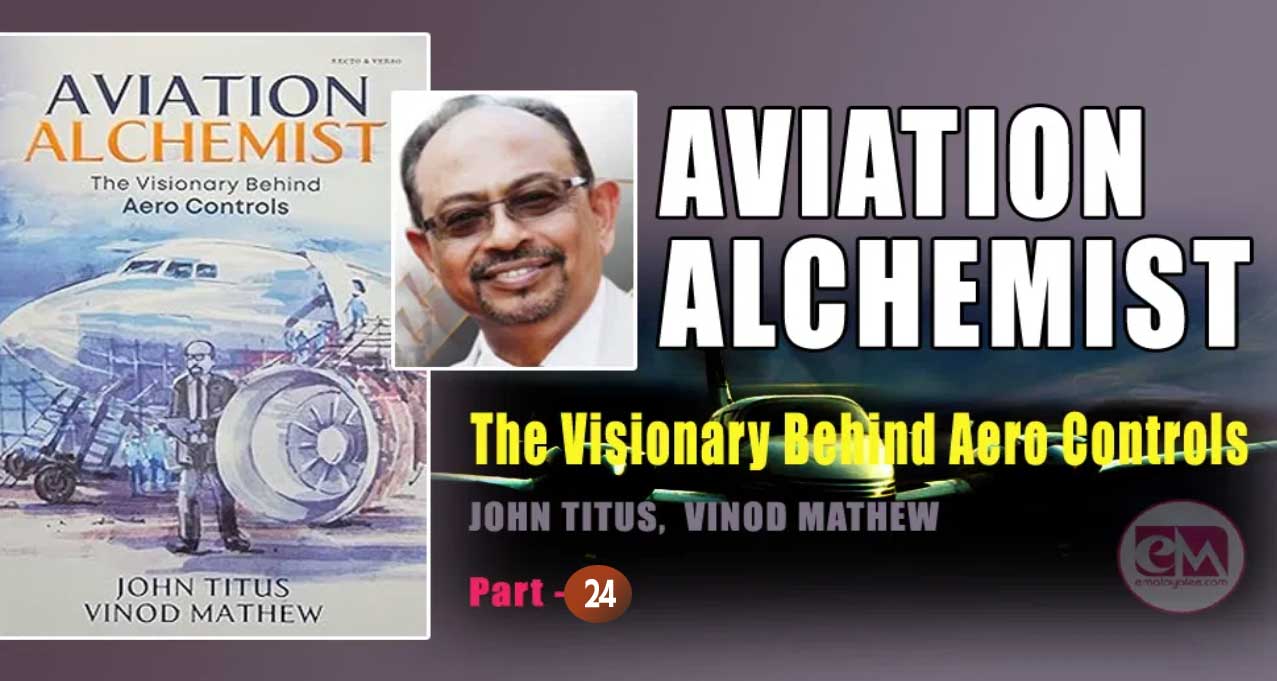
John Titus's Aviation Alchemist -The Visionary Behind Aero Controls (Part -24)
AIR INDIA, AIR KAZAKHSTAN
IN 1998, AIR INDIA WAS TRYING TO SELL TWO 747-200 AIRCRAFT through a bid process. This was not how it was done in the Western world and the process was unfamiliar to most outside India. I had an agent in India, Mr. Jibu Cherian who was familiar with the process and so, we made a bid.
There were only two serious bidders including Aero Controls. The other one too was from the US, an airline company from the state of Oregon. We successfully outbid our competition and secured the purchase of one of the aircraft.
Taking into account the taxes as well as legal complications, it was decided to sign the closing documents in Bangkok, Thailand. As per the contract, Air India was to ensure the aircraft was airworthy and fly them to Thailand. Once the deal was done, pilots representing Aero Controls was to fly the aircraft to Mojave, California.
All transactions and correspondence were handled by our Vice President Jeffery Stabile. I was not in the picture as I did not want the Air India management to know the owner of the company was an Indian.
Jeffery was very pleased with the Air India team. They all went out of their way to help with anything he needed. Once the air-craft was ready, a group of Air India employees including pilots, maintenance crew and contract crew along with Jeffery, flew over to Bangkok.
The deal was closed and we hosted a party at the hotel with Air India employees and our pilots. The next day, as our pilots were getting ready to fly the aircraft, they noticed that fuel was leaking from under the wing. All large aircraft store the fuel inside the wings, in separate compartments. Since we did not have any maintenance personnel, we had requested Thai Airways help.
After inspection, they informed us that there were cracks near the wing root area, adjacent to the fuselage. This had been repaired by the Air India staff, by using adhesive externally. It had lasted only till the aircraft reached Bangkok, but started leaking overnight. This was not a legally approved repair.
Once we confronted them with the matter, the Air India team initially denied any knowledge of the repair. However, they were forced to retract once the Thai Airways inspection team confirmed the repair. Then the Air India team claimed they had only used mate-rials approved by Boeing and blamed the adhesive manufacturer.
Since Air India was not willing to own up to their mistake, we had no option but to get the aircraft fixed and fly back to the US. This repair required the aircraft to be fully de-fueled, vent the tank crawl in the tank and repair the crack from the inside fuel tank.
The repair cost us $36,000.00.
It took us two days to get the aircraft ready and flown to Cal-ifornia. Since the illegal repair was performed by Air India, it was fair for me to ask Air India to pay for the repair. They refused. They claimed that the aircraft was sold "As is, where is" and stated they were not willing to take any responsibility.
I was very upset but tried to negotiate. Air India kept saying that they were not liable for the repair. We decided to sue Air India in the US because the contract did specify New York law. So I filed a case against Air India in the district court. Air India's attorney decided to move the case to the Federal court.
A few months went by with Air India spending a lot of money on their attorneys. Soon, it was recommended to them by their legal advisors that it would be advantageous for Air India to settle. They had no option but to reimburse us for the cost of the repair. They had already spent at least twice as much in legal costs.
As a businessman, I was curious to know why Air India ended up paying over $100,000.00 when they could have easily settled for $36,000.00 and hence the decision to fight a legal battle that was as good as lost from the very beginning.
When I found out the reason a few months later from one of my acquaintances in Air India who was involved in the deal, I thought it was nothing short of criminal apathy. He privately shared that paying $36,000.00 would have shown the company was admitting to its guilt.
However, paying the same amount after going the legal route, no matter the additional attorney fees was acceptable. In the next six months, the aircraft was fully disassembled and sellable parts were shipped over to our Shelton warehouse near Seattle.
It is not that we were never caught unawares in our business transactions. An incident in 1991 could have easily spelt the end of our business. It could only have been the aggregate of all our good deeds in the past that bailed us out that one time.
We were even blamed for an air crash though our mistake was unconnected to the disaster. It was a harrowing time till our good name was cleared and Aero Controls came out with its reputation intact.
It all began with one of our many repairing assignments. We were repairing a hydraulic component called Rudder PCU which was used on 737 aircraft by a few airlines. One of the new tools we were using to torque down an internal component was not able to read the torque right. This resulted in an error in the lower torque of some 15 units repaired by Aero Controls.
As soon as we realized the mistake, we immediately notified the FAA, the airline and Boeing which is the manufacturer of the 737 aircraft. We purchased all Rudder PCUs available in the market and offered them to the airlines so that they could replace the defective units. This plan was executed as approved by both FAA and Boeing.
Now, there is a side story here, the one that nearly finished us off. The Rudder PCU is a flight-critical component. There were a couple of aircraft accidents that were tied to this component and investigation was still ongoing. The manufacturer of the PCU was unhappy with the settlement with the FAA and Boeing.
We were their major competition and they wanted us out of the way. So they used their political influence to issue an Airworthy Directive (AD) against our company. This was very damaging to our reputation as this AD goes to all airlines.
It was doubly unfair as by the time AD was issued, we had already identified all defective units and had issued the replacement units to each airline to whom we had supplied the PCUs. And they in turn had carried out the replacement. All the airlines were happy because we offered a solution to their satisfaction without any cost.
Unfortunately, this AD had gone to all airlines and news media around the world. Quite a few national news media teams were soon camping outside our building. To make matters worse, there was a United Airlines crash that evening and the media started blaming us. The onus was on us to prove that it was a baseless charge.
We had to clarify what happened and explain that there were no aircraft crashes related to this incident. Once the media and airlines understood what happened and how we handled it, it was no longer an issue. But, for us, it was a harrowing experience. Things became clear as to why our company had to face all that trouble when an FAA inspector who I knew had a chat with me.
"John, you may think you were a small company but the PCU manufacturer thinks you are a threat to their business. They would not hesitate to use their political influence to put you out of business. So I suggest you establish political influence both at the local and national levels," he told me.
I took his advice seriously. Over the next couple of months, I started getting involved in many political fundraising shows, regardless of their political party. With the help of my friends Dr Happy Walia and David Malik, I became an active player in many fundraisers.
The political influence that I started cultivating proved quite helpful over the years. The fact is, I did not have to wait too long to leverage my fundraising activities.
Back to 1998. The tenure of the contract between Triple J Leasing and Ryan International was nearing its expiry. We were looking for a new lease possibility with a longer-term option. We were told by a few leasing companies that an airline out of Kazakhstan was looking for a Western aircraft for a five-year lease.
No one wanted to lease out to them, neither dry lease nor wet lease, as the country had recently broken away from the old Soviet Union. The political stability was suspect. Moreover, the country's aviation sector had no experience in leasing. However, I saw this as a great opportunity to introduce a Western-built aircraft in this region.
Every leasing company I talked to approved the idea but not one was willing to walk the talk and practice what they were preaching. I had made up my mind. I had to take a chance, because the way I saw it, this was a risk worth taking, the returns could be substantial. What tilted the balance was I seemed to be the only one even considering such a project. The field was clear, I had a guaranteed monopoly. Soon, we invited them to Seattle and signed a Letter of Intent. That was only the beginning.
The client, Air Kazakhstan, was the country's national carrier. The top management at Air Kazakhstan did not speak any English and had to take the help of interpreters. This was quite challenging. After 3 days of intense negotiations, there was no breakthrough in sight. It was quite frustrating.
So the next day I told the group that I wanted an agreement by the end of the day. If they were unable to reach an agreement I was going to terminate further negotiations and keep the deposit money. That was my ultimatum.
While all this was happening, the aircraft was going through a complete overhaul worth $1 million, at a facility in Costa Rica. I addressed the negotiating teams en masse and declared that I would be returning at 5 p.m. to sign the lease agreement, so better keep it ready. At 5 p.m. sharp, I walked into the conference room. I was amazed to see that both sides were working in tandem and about 50 per cent work had been completed. It was never my intention while laying down the 5 p.m. deadline to walk away. The trick had worked, as the Kazakhstan team thought I was about to abandon the project.
I told them that I was going to leave the table until a complete agreement was ironed out. I always knew the best technique in putting a deal together was to drive home some critical points when everyone was tired. My walk-out threat had forced the hand and they had no option but to agree to many of my terms.
Thus, after protracted discussions, a contract was put together by 11 am the next day. Effectively, it was a five-year lease for a total value of $6.5 million between Air Kazakhstan and Aero Controls. Many of the terms and conditions were new to them as this was their first leasing deal. Everyone was tired but I had the satisfaction of getting it done. I went straight to the airport to catch the next flight home.
Once the overhaul and modifications to the aircraft were com-pleted, I decided to bring it to Seattle and hold a delivery ceremony at the Boeing field. This is where Boeing delivers new aircraft to their customers. We also invited the Boeing management to be present. There was much confusion the day before the function as it was found that the aircraft had not complied with the customs regulations. The aircraft had been flown by Air Kazakhstan pilots from Costa Rica.
The problem arose as it first stopped in Houston for refueling before proceeding to Seattle. Once the aircraft landed in Seattle, we realized that the pilots had not procured the mandatory customs clearance in Houston, for flying into American airspace.
We had to push our attorney into action to sort matters with the customs department. The aircraft delivery and ceremony went smoothly. Our Director of bus development along with our attor-ney accompanied the aircraft to Almaty, Kazakhstan. After a brief ceremony the aircraft was out into service.
For the next three years, everything was smooth sailing as we got our payments without any hiccups. Suddenly one day Air Kazakh-stan contacted us saying that they did not require the aircraft any longer. The aircraft was parked in Budapest, Hungary from where we were asked to go and bring back the airplane.
It was in clear violation of the legalities binding the five-year con-tract signed in Budapest between Aero Controls and Air Kazakhstan
As only three years had lapsed, the terms and conditions of the contract were still binding on both parties for another two years before the leased aircraft could be returned. Hence, the dispute could be redressed only by the International Arbitration Tribunal.
So we sued them at the International Arbitration Court in Switzerland for the remaining lease payments and damages. The tribunal consists of three Judges. Both parties can appoint one judge and the international court will appoint one as well. Thus, the panel consists of three judges and the majority rule applies.
It took nearly two years before the hearing took place. The trial lasted one week while the verdict came three months later. We were unanimously awarded $2.5 million in damages. All that was fine and it went along the expected lines. The real challenge was to follow. How were we ever going to collect the money from a country that had very little commercial dealings with the US?
They started making some small payments, but nothing sub-stantial. Then came the shocker. Kazakhstan Airlines filed for bankruptcy. We knew the airline was owned by the Kazakh gov-ernment. So we decided to go after the government. I decided to use whatever political influence I had to get the job done.
I immediately got in touch with Congressman Adam Smith whom I had supported from his first campaign. He met up with me along with one of his assistants. Once he was fully briefed about what had happened, he took up the matter with the US Ethics Committee.
They cleared the case so that it could be taken to the next level as the party involved was a foreign government which violated international arbitration rules.
Congressman Smith took up the matter with Secretary of State Collin Powell. During the next meeting with the Deputy prime minister of Kazakhstan, the United States government added our dispute to the agenda for their meeting. The Kazakhstan government was caught unawares.
A few intense phone calls to Astana followed. Within no time, they conveyed their decision to make the payments. I felt exonerated for having cultivated political goodwill as that alone had led to such intense lobbying on my behalf at the highest government level.
My stand-off with Kazakhstan Airlines became a case study for US-based companies on how a foreign government that refused to follow international rules could be brought to book by the US government.
The highest number of aircraft we purchased were Boeing 727s. We purchased over 50 Boeing 727 aircraft. Most of these were dismantled, with the reusable spare parts getting reconditioned and sold to airlines around the world.
Our association with both Air India and Air Kazakhstan wound up in legal battles. Yet, the experience thus gained opened up the window to a new and sustainable business model.
Read More: https://www.emalayalee.com/writer/313

EMalayalee Available in MediaAppUSA



Copyright © 2024 emalayalee.com - All Rights Reserved.
Webmastered by MIPL, Web Hosting Calicut Kerala