

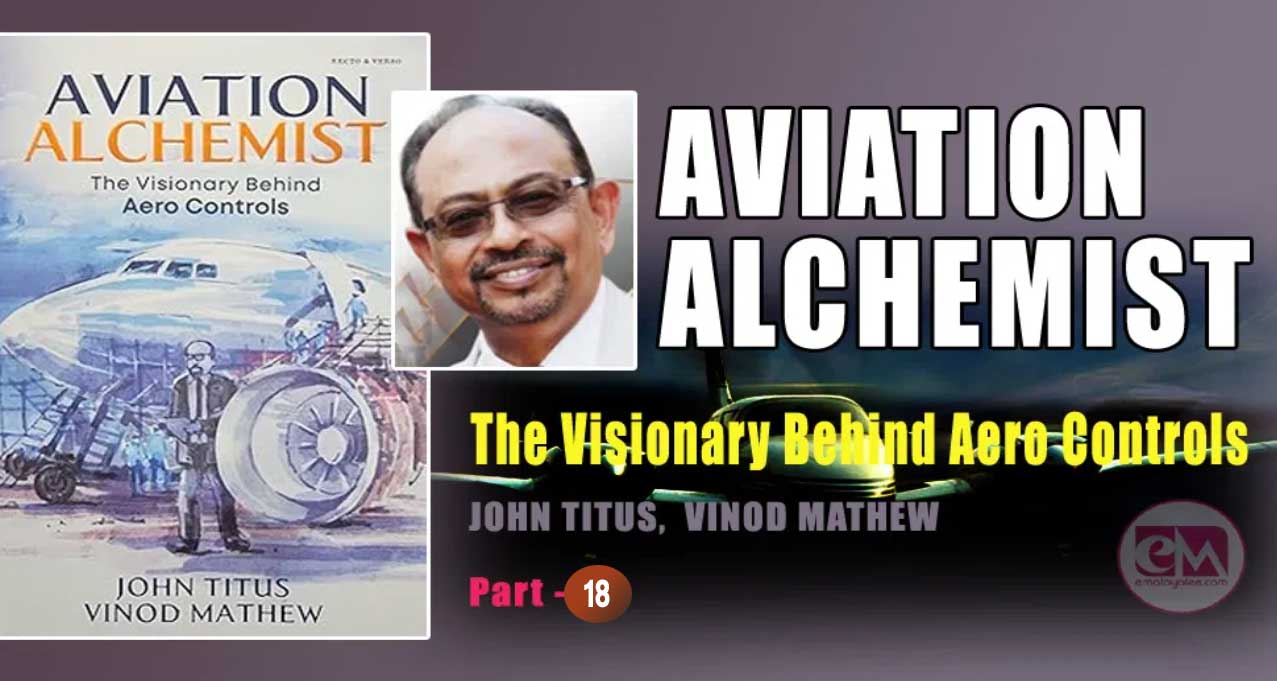
John Titus's Aviation Alchemist -The Visionary Behind Aero Controls (Part -18)
AERO CONTROLS -CONCEPTION
THE FIGHT FOR CONTROL AT WIN AIR PROVED TO BE A HAR-rowing experience for me. All the more so as this was my first attempt to turn entrepreneur, having till then worked for an assured salary. Therefore, this fight for control of a company where I had a 50 per cent stake and the resultant parting of ways with Bill Perdue, which in other words meant my exit from Win Air, led to a period of absolute uncertainty.
It was clear that I needed a break, even if a brief one, from all this corporate warfare. I decided to take a mini vacation in Houston where I had a cousin Dr George Mammen. I must admit the choice of Houston was not made without deliberation.
Once in Houston, I decided to pay a visit to my old-time friends at South West Airlines, Ron Clair and Elliott McCullough. We had
a brief meeting and went out for lunch. For all practical purposes, it was a meeting between one of the partners of Win Air and the representatives of the company's most important client.
As they were getting out of the car, Elliott asked me "How are you doing with your partner?" My reply, "Do you want to know?" made him realize something was going on. Elliott asked me to visit him in his office after the lunch. I followed him immediately and once there I told him everything.
He was quite candid. "John, we are doing business with Win Air because of you. We never trusted Bill. If you go on your own you can expect our business as we will no longer be with Win Air," he said to my great relief. It was that one meeting that vindicated my decision to start my own business with all confidence.
In the years that followed, South West Airlines kept this promise. Every year, consistently, SWA was our number one customer. It was a strong trusted partnership that would last the test of time.
It was in September 1984 that I stepped out of Win Air. It took another 6-7 months to completely disengage myself legally. But I could not wait too long to start Aero Controls Inc. (ACI), which I did the very next month, in November 1984.
For the first six months, Aero Controls operated out of my garage. Some of my friends still pull my leg about having the garage part in common with Steve Jobs who started Apple in his parents' garage!
I was not legally allowed to start a repair station as it would have been a conflict with Win Air where I was still a 50 per cent partner. Yet, I could start my own sales company as Win Air was not a sales company and I had no conflict of interest there.
The first order for Aero Controls was worth $128,000.00. We were required to deliver 727 transmission or power transfer units to
People Express Airlines through a company called Time Aviation in Southern California.
I took up that order in partnership with Time Aviation. Those were the days when it was hard to find 727 transmission units in the market. We had won the bid but had no idea how to procure so many transmission units, which essentially enable the transfer of hydraulic power in the aircraft from one system to another.
We were gambling as an inventory management system, those days, was in a nascent stage. What happened was we were required to physically scout around for components and laying our hands on 727 transmission units would be no different.
During my many travels, I have always asked the airline or parts company if I could visit their stock room. Once I physically verified the parts availability, I would jot down the location and number of available units, especially when the number of spares was on the high side.
We had also put the word out through intermediaries about our requirements. I would get phone calls from various airlines about the number of transmission units they could spare and the deal would be struck.
I sometimes even had to convince some airlines that they had too many units in their inventory and that they should sell a few. Procuring 727 power transmission units within a limited timeframe proved to be quite a difficult task.
Most of these airlines shipped these units which we picked up at the airport, changed their labels and shipped them out again, to the customer. On average we procured these transmission units at 60 per cent of the listed price whereas People Express had signed up to pay 80 per cent. The margins were great and we were reaping great profit but my passion was always aircraft component maintenance.
By March, Win Air finally wound up operations. We decided to split everything as much as possible. If there were two desks I took one and Bill took the other. When there were five chairs we both took two each and left one for us to bid. Finally, we bid everything we could not agree to split.
One partner got the goods while the other got the cash. There could be no such splitting with the 12 employees as they had the freedom to go with the one of their choice. Bill may have been a bit surprised when 10 out of 12 decided to come with me to Aero Controls.
If anything, there could no longer be any debate regarding who was the popular partner at Win Air. All this while, we were getting flooded with work orders from various airlines which saw Aero Controls as a continuation of Win Air, with me at the helm.
The sad truth was we were in no position to take up those orders as we did not have the certification to do work. This was unthinkable. We were losing goodwill by turning down work.
It did not make any difference that we had rented a 3000 sq ft space in Renton. A combination of warehouses and offices. We also had an option to add another 1500 sq ft. It was a three-year lease. But all this would remain a non-starter if there was no certification for which I had already applied.
The Federal Aviation Administration (FAA) team kept prom-ising to show up but somehow they failed to turn up. I decided to take the bull by its horns. After two weeks I called the FAA office and told them that I could no longer afford to keep people on the payroll and gave notice that I was going to lay them off.
They got the message loud and clear. Their top official apologized and told me that they would send an officer to inspect our facility without any more delay. They send an inspector the next morning.
He conducted a thorough inspection that lasted over four hours. He was satisfied with what he saw, both the building design and the processes that were in place and ready to go. He was completely surprised to see the amount of jobs we had lined up.
It was clear that this was a genuine venture with multiple clients openly reposing faith in our capabilities by committing a string of aircraft repair jobs. By the same afternoon, he came back and handed us our FAA certification. On April 18th, 1985 Aero Con-trols, became an FAA-certified repair station.
Read More: https://www.emalayalee.com/writer/313

EMalayalee Available in MediaAppUSA



Copyright © 2024 emalayalee.com - All Rights Reserved.
Webmastered by MIPL, Web Hosting Calicut Kerala