

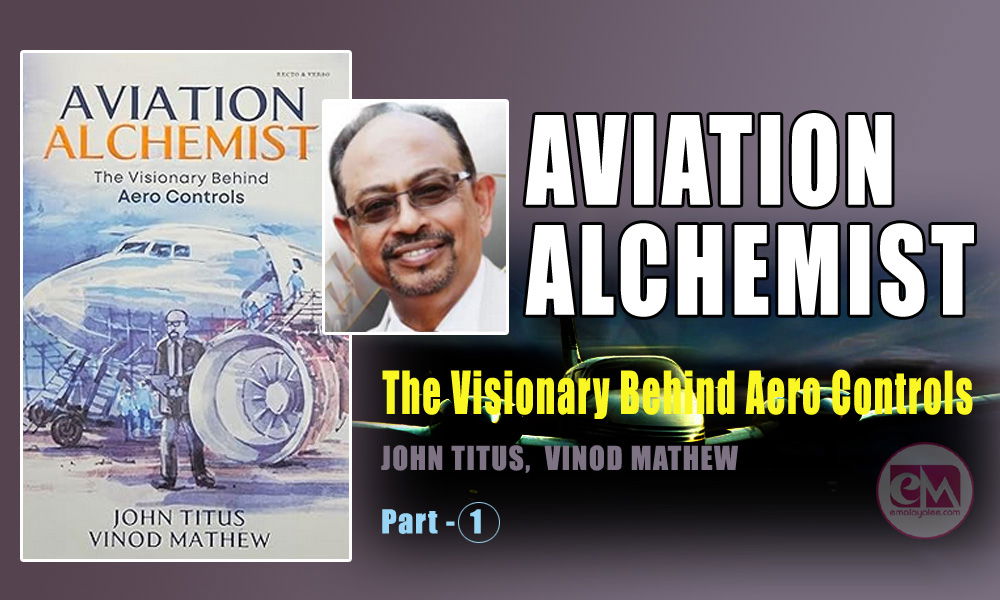
AVIATION ALCHEMIST -The Visionary Behind Aero Controls - Part -1 (JOHN TITUS, VINOD MATHEW)
DIE-HARD ENGINEER -BACK STORY
ALL STORIES HAVE TO BEGIN AT SOME POINT. HOWEVER, A FEW stories require some investigation into why and how the story begins the way it does. The story of John Titus or Babu to those who were close to him mandates such a back story. Otherwise, the story will be illogical. Try this one for size. Why would an Economics, History and Political Science degree student, right after his graduation, go full throttle ahead with a plan to enroll for Aeronautical Engineering on the West Coast of the US? Was it a random decision? Did he do it because his parents could afford to send him to the US for a finishing course in a field where he had no exposure till then?
We need to go back to the year 1966 to trace back how John found himself with a degree in History, Economics and Political Science in 1971. Especially so, as we are referring to a student who scored high in Mathematics and Science in bis class 10 public examinations.
For young John, it was a year of reckoning. He was finally moving out of Noel Memorial High School, Kumbanad and the choice was either St Thomas College, Kozhencherry or Mar Thoma College, Thiruvalla. The first one was about 9 km and the latter about 13 km. Naturally, like many of his classmates, John wanted to go the full distance. In the pecking order of aspirational colleges, Thiruvalla fetched up way ahead of Kozhencherry, though visibly behind Kottayam, Ernakulam and Trivandrum.
Those days, as it is even today, a pre-degree or as they are known now a plus-two student considered admission to the Science stream (second group) as the ultimate thing, followed by Mathematics and Physics (first group) to be the next best outcome.
Thereafter, things went into a free-fall as those who failed to make the grade, shuttled between commerce and arts streams, also known respectively as the third and fourth groups (arts and commerce streams).
So, we had, on the one hand, young John who even as he was a high school student was passionate about studying Mathematics and Physics and on the other hand a commonly held view that spelt out the supremacy of zoology and chemistry over other subjects. Therefore, he was determined that he would not fall into the science trap and told his father quite succinctly that he wished to pursue the mathematics-physics combo in college as the latter set out to Mar Thoma College to secure admission for his son.
So, John's father landed at Mar Thoma College, Thiruvalla and made a beeline for the one person he not only knew but was a relative, Prof O A Cherian, who happened to be the head of the Chemistry department there. Once he was told the visit was about John's admis-sion, the good professor asked for his son's mark list. Finding that John had scored high in science, the professor gave his verdict: "Your son is doctor material. Let us forget about what he wants and get him into the second group: The second group was the one John abhorred, a pure science stream as against the first group comprising mathematics and physics, the subjects he adored.
When John's father returned home, he bore the glad tidings that his son had been admitted to the highly sought-after second group. John was despondent as there was no way he could pursue the subject of his choice-Mathematics- all because the professor thought otherwise. Young John was disappointed. But that was a time when he could not dream of going against his father's word. He joined the science group and promptly went into a near-total disconnect with academics. The ensuing two years was pure hell for John as he merely went throughthe motions of attending classes.
John was not fond of drawing, a critical part of studying Life Sciences and Chemistry. He was asked not to attend the laboratory sessions for an entire year on account of bunking one class. Naturally, he flunked the exams.
There was only one solution available to all those who were required to take the supplementary examination to clear failed papers- to join the neighborhood Triumph Tutorials! Even that was not to be. John was asked to prepare for both theory and practical examinations, something he had no wish to do.
Eventually, a cousin who was an engineering student came to his aid. Together, they made sure that John mugged up all the laboratory procedures by heart. He passed with flying colors.
John recalls that there were three other students in the same boat, as none of them had any liking for Science. All four of them landed up in St Thomas College, Kozhencherry next year as students of Economics, History and Political Science, but not before they had lost one year.
By the time he completed his pre-degree course, it was clear to all, including his father that John needed to be given the freedom to choose his academic stream for his degree course. However, it would be prudent to juxtapose this decision with the only trip he went on, away from home.
It was this trip with some of his cousins and friends of his age group that finally unshackled him from the clutches of his parents and other elders, who would otherwise have had a say in what he would study in college for the next three years.
It was 1968 and John had just completed his pre-degree course. Some of his cousins decided to volunteer with CASA (Christian Agency for Social Action) which was engaged in volunteer work in financially backward villages in rural Andhra Pradesh. The main motivation for many of them was that this trip gave them a chance to get away for an entire month from staying put at home.
It was an eye-opening experience for John as he got footloose with bis Kumbanad pals Kanakathil Johny, Poovannammotil Baby and two other young men from Hyderabad.
These five youngsters stuck together as a team, working with locals to build mini-irrigation systems for the village comprising thirty-nine families living nearby. There was no running water and all their needs had to be met from a common well which was nothing more than a small pond. People walked down the well, took a bath and fetched water for drinking and cooking. It was filthy. John and his friends got sick. There were a few other villages nearby but they were warned not to go there due to leprosy infestation.
This is how John recalls those days, "Villagers welcomed us with open arms and made our stay comfortable. Acres and acres of mango orchard were a sight to behold."
But they could not wait to return home, which they did before the scheduled period was up. It was an experience that instilled enough courage in John to proclaim to all, including his father, that he was no longer willing to study Science, a subject he was not interested in. As if striving to put a safe distance from Science, John chose to enroll for a B.A. with Economics as the main subject, and Political Science and Indian History as the subsidiaries.
John was about 17 years old when he joined his degree course and found he had a passion for Economics, primarily out of his love for Mathematics, which was still alive. The one subject that he could not come to grips with was Political Science, a fact that he keeps remem-bering on and off. This proved to be a saving grace.
He did nurture hopes though and became active in student politics. In hindsight, he could not live up to what was expected of him to become a real politician.
He was not cut out to be a politician in the real world; it did not come naturally to him. Had he excelled in this area, John would likely have enrolled for a master's degree in law in the state capital. Who knows, he may even have tried to join mainstream politics.
Luckily, he was not good at it and therefore was forced to look at options in the US. That too in a subject that engaged his passion for Mathematics and Physics-Aeronautical Technology.
John did not know at that time that pursuing aeronautical tech-nology in the US did not require him to have a degree in a related subject. Perhaps that is why he was persuaded by his friends to procure a diploma certificate in engineering from a local institution. Luckily for John, he never had to use it even once in his life.
There could have been multiple outcomes in career choices for a student like John who was pushed into studying a subject in which he had very little or absolutely no interest. Many similar stories have seen a reluctant doctor in the making, who over the years, would strive to gloss over the fundamental truth that he is an accidental doctor.
John, having chosen to break free from the steres-typed obedient son pursuing his father's wish by branching out into a degree course in Economics, History and Political Science could then have become a lawyer, teacher or politician.
This was the more likely outcome, as it has been and continues to be for many students who abandon science to embrace liberal arts.
This is where John stood apart, by revisiting his original plan to study mathematics and physics. Not merely that. Here was a youngster, who was just out of his teens, coming from a rural upbringing with only limited exposure to city life as defined in Kerala in the late Sixties. Not only did he muster enough courage to embrace the American way of life as soon as he landed on the West Coast, but he managed to juggle multiple jobs, many of them requiring physical labor while studying aeronautical engineering.
By no stretch of the imagination was this an easy task for a lad who could barely understand the American lingo as spoken by all around him, except the Malayali community!
John proved he was made of sterner stuff, as a lesser man would have cut and run any time during the initial couple of years. What defies logic is how John, with absolutely no history in his family of doing business, could take that big leap of faith by starting an enterprise of his own. And running it for the next 40 years.
As to how he found his way to the US, that too with little financial backing from his family that was burdened by the weight of bringing up his many siblings, is better narrated by John.
What could be better than getting to hear John's action-packed story in his own words, with only the occasional instance of third-party intervention? That too, only in the rarest of rare cases, to give his narration an outsider's perspective.
Thus begins the John Titus voyage across the many seas.
>to be continued

EMalayalee Available in MediaAppUSA



Copyright © 2024 emalayalee.com - All Rights Reserved.
Webmastered by MIPL, Web Hosting Calicut Kerala