

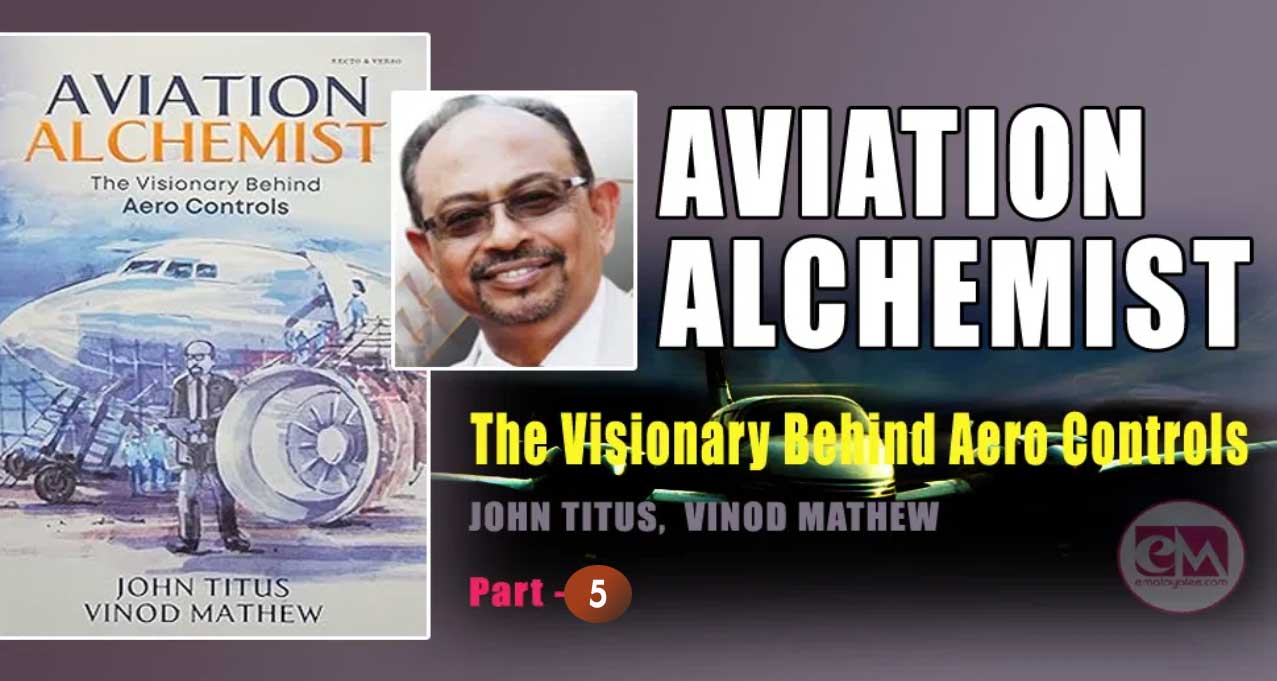
John Titus's Aviation Alchemist -The Visionary Behind Aero Controls (Part -5)
TIME TRAVEL
ONCE THE SNOW FALLS, IT IS LIKE AN UNOFFICIAL CLARION call to get ready for the Christmas season. The shops start wearing a festive air, most houses pull out their old Christmas trees; many even get new ones. There is a general sense of anticipation in the air as the Yuletide sets in. This is how it is in most of the western hemisphere and Washington State is no exception.
As for me, I had no clue how my first Christmas in the US would turn out. That is until my cousin Tom started insisting that I should spend my first Christmas with his family. He had lots of friends in Eugene and many relatives, most of whom were also related to me.
It was the first time I would get to meet my first cousin Josephine who was a student at the University of Oregon. Her dad and my dad are brothers but her dad K J John had left India in the mid 1930 for Malaysia and they had not exactly been very regular visitors to their native place.
Our family had faced a huge financial crisis during that time. My grandfather and his brothers and cousins were all farmers.
The story goes that in 1761, a Hindu Brahmin who worked at the local king's palace was converted to Christianity. He had faced much opposition from his community and was persecuted.
He knew that there were a lot of Christians further north of his village. So he travelled and came to a place where he found a Christian settlement. He had reached the house of Easow Panicker, a prominent Christian. The surname Panicker was bestowed on him by the local king for his act of bravery. This is something similar to "Lord" or "Sir" given by the ruler of the UK.
As Easow Panicker was not home, his son Kocheasow, who was only 14 years old, took care of this Brahmin. After his conversion, this Brahmin changed his name to Yohannan which is in Malay-alam, John the Baptist.
Soon, Easow came home and Yohannan requested that he be provided a quiet place where he could pray in peace. Easow had suggested an area a couple of miles from his house. It was a hilly forest area that had a sizeable population of wild elephants. He sent his son Kocheasow with Yohannan as his companion. When they reached this area, the first thing they did was to build a chapel for prayers.
Thereafter, they built a tree house which would keep them safe from wild animals. Later Yohannan built a proper house for Kocheasow and found him a bride named Mariamma.
Kocheasow had three sons. In a few years, they cleared the forest near the chapel and converted it into farmland. As the sons got married, they too built houses in the vicinity of the chapel, which by then had grown into a full-fledged church. Over a while, this settlement came to be known as Kumbanad which meant the land of Kumbi or elephant.
My grandfather was the fourth generation descendant of Easow.
During that time, many missionaries from the West came to Kot-tayam and Thiruvalla. They came from England and other parts of Europe, even New Zealand, to establish churches and schools in many parts of Kerala.
Their generation knew that the only way to progress was to send their children to school. Even though there were schools already in existence, the students were taught everything in Malayalam.
The new schools were mostly English medium and promised good jobs in the government. Those days money was a rare com-modity. Most of the trade was executed using the barter system. So every family pushed at least one male member of the family to get higher education, even a college degree.
But higher education did never come cheap. Not then, not now. During my grandfather's time, the only way to raise the necessary cash for sending out children to study was to either sell the property or take a loan against property.
The plan was for the young ones seeking higher education to repay the loan or buy back the property once they secured a monthly salary.
Thus, my grandfather sent his oldest son KJ Thomas, who was a bright young man, to college. As fate would have it, shortly after getting his BA degree, Thomas succumbed to tuberculosis. To make matters worse, two of his brothers also had TB. There was not much treatment for TB in those days. Mostly, they were kept in isolation to see if they would recover.
My father K J Titus, who was younger than his two brothers, watched helplessly as they decided to join the Pentecostal move-ment and as they eventually recovered, they believed that they were cured by prayer.
One of these two, KJ Philip, eventually became a Pentecost missionary and came to the US where he studied Theology. There, he managed to take not one but two back-to-back doctorates in the late 1940s.
After Thomas died, my grandfather faced a severe financial crisis. He was in deep debt, with no income to dig his way out. The children had no option but to seek solutions on their own. So KJ John left for Malaysia along with the youngest of the brothers KJ George.
My grandfather had become a widower at a young age as my grandmother passed away when my father was about three years old. So it was my grandfather's mother who had brought up my father and his siblings.
As the financial crisis loomed, and as my father could find no other source of a steady income, he joined the army. The British used to rule India at that time and so it was the British Indian Army that he joined.
My father served in the army during World War II. As luck would have it, he was posted in Israel during its formation in 1948. As a young boy, I grew up hearing many heroic stories about my father's world war exploits.
There were months on end when my father could not com-municate with the outside world. Why, there was a long period when my grandfather never received any letters from my father. During the time, it was feared that he had perished in the war in some far-off land.
Those were the days when letters were the only form of com-munication. My grandfather cherished all the letters he received from his children. My father's elder brother K.J Abraham was the only one who stayed back and took care of my grandfather's considerable landed property.
My grandfather was a kind and God-fearing man. He died when I was only three years old. I have heard many stories about him, of which one that was narrated by Uncle Abraham remains fresh in my mind even today.
Somewhere in the mid-1900s, there was a group of Christians who believed that Christ was going to come soon. They were quite specific about the arrival - it was to happen in five-and-a-half years, according to the vision they had.
Several gullible people sold off their property, donated the proceedings to a newly assembled church and began to live a communal life. Those 66 months were eventually over, Christ had not been sighted in the Kumbanad area by the devotees, or if he had been, it was a well-guarded secret.
They decided to cross-check with two men of God in their community. One was Yohannan, my grandfather, and the other was his cousin Mammen who was a priest. People believed that if these two were still on earth, Christ could not have come.
For many days, those who had sold off their land and donated everything to the new-generation church, started peeking into the courtyard of Yohannan and Mammen, to ascertain they had not departed.
In a few days, it became clear that the five-and-a-half-year window for the return of Christ was a hoax. The leaders of this new church began to flee the area. Soon, everything was peaceful in Kumbanad. For a while.
Growing up in Kumbanad was an experience that not many can easily forget. Especially, Kumbanad Mar Thoma Valiyapally and its surroundings. I clearly remember our church celebrating 200 years under the leadership of Rev N.K Yohannan many decades ago. We were then a large group of youngsters, mostly cousins.
Today most of them have returned to Kumbanad after years of service both in other parts of India and abroad. There is also a sizeable Kumbanad population settled in countries like the USA, Canada, the UK, Australia and some relatively unknown countries you can find on the Atlas.
I had not realized at that time that our church was one of the few churches that hitched our wagon to the Mar Thoma congregation after the great reformation that saw the breaking. In other words, our church was in existence long before the Malankara Mar Thoma church came into existence.
Consequently, the stories I narrate here about my forefathers, and subsequently about my own life, should come with a semblance of credibility, right?
So, when I narrate the story of my primary school days when I would cut across the paddy fields of the Kochupurackal house, it is but yet another page from the book called Kumbanad.
During monsoon season, pretty much like what one could see in other parts of Kerala, the fields and streams were full of muddy water, This is where we played and got ourselves wet and dirty. Later as a young man, I spent many nights catching fish under the friendly guidance of Kanakathil Kizhakethil Appachen, who was a bit older than my father.
He was an avid fisherman and always encouraged us to pursue fishing as a hobby. If I enjoy fishing in all parts of the US even today, it is him that I need to thank. While on the topic, my secondary and high school education was at Noel Memorial School, where all teachers were known to my father who had a hardware store next to the entrance of the school.
It also mattered that several of them were his cousins. They never hesitated to report any misbehavior arising from my side, I suffered the consequences later at home. The flip side was that there were
several of my cousins in the same class. We had a wonderful time growing up together.
The headmaster, N.J Chacko sir, too was my father's cousin.
Each morning, once the warning bell was sounded, he would stand outside his office, to see who was coming late. Even then, he would be lenient. As long as you ran to the class he was okay with it.
I thought it worthwhile to sketch a thumbnail of my school days as you already know how it went for me in college, leading up to my maiden journey to the US and my life there.
Read More: https://www.emalayalee.com/writer/313

EMalayalee Available in MediaAppUSA



Copyright © 2024 emalayalee.com - All Rights Reserved.
Webmastered by MIPL, Web Hosting Calicut Kerala