

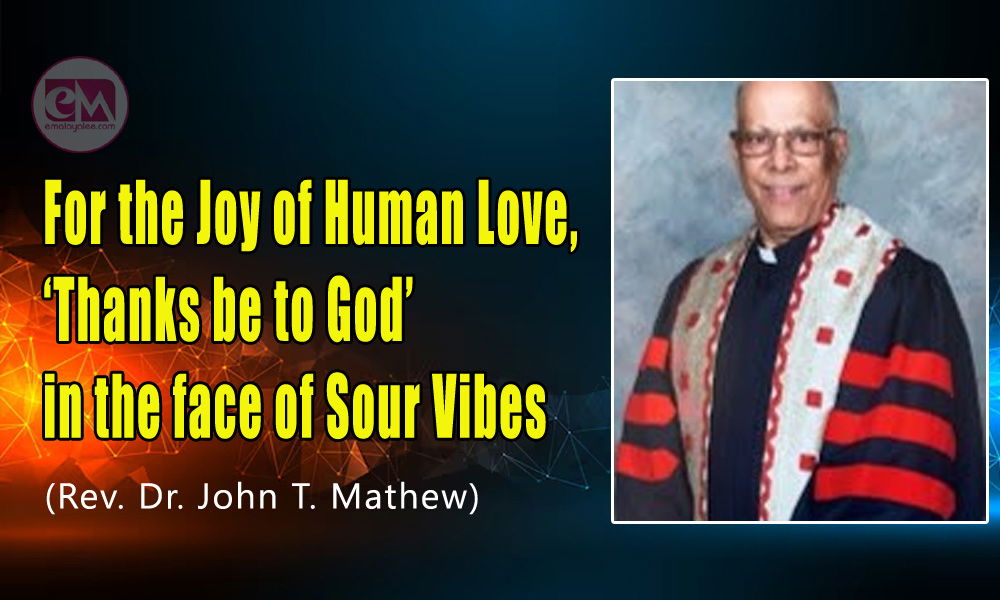
For the Joy of Human Love, ‘Thanks be to God’ in the face of Sour Vibes (Rev. Dr. John T. Mathew)
A desire to slow down, look back and demonstrate an expression of appreciation is ingrained in animals including humans. Don’t we easily figure out when a happy dog wags its tail with submissive grin, or a cat stares and offers a purr-fect snuggle. For sure, rational human are hardwired to value gentle gestures and generosity of others.
Autumn, Albert Camus reminds us, is a second spring when every leaf is a flower. Also known as ‘fall’, it is the season of sassy splendours and speedy shifts in nature. Those who live in the north vamoosed from an unseasonally scorching summer and hailed autumn, one of the four pleasant seasons on earth.
Therefore, “it’s that time of year” when our feathered friends, prompted by nature and instinct – Canada geese – migrate south for the winter in southern United States and northern Mexico and when dazzling crimson vegetation transmutes the tundra of Northwest. Wildlife would begin to migrate to warmer south, store food for rainy days, hibernate and grow thicker fur or feathers. Risk-taking farm workers look forward to less gruelling chores during the winter. All creatures of habit hanker to be happy by soaking in the beauty of life.
An AI-driven daredevil life inevitably offers us exciting and gratifying experiences as well as bold enthusiasm and open door to forge ahead, strive harder and thrive. One of the well-known songs of praise of this season reminds us:
‘We plow the fields and scatter the good seed on the land
But it is fed and watered by God’s almighty hand.
God sends the snow in winter, the warmth to swell the grain,
The breezes and the sunshine, and soft refreshing rain.’
Whether faithful or ‘spiritual but not religious’ in our own brash or shushed traditions we acclaim and proclaim that “all good gifts around us are sent from heaven above.” The Psalmist summons us "let everything that breathes praise the Holy One!" (Ps. 150)
Canadian Thanksgiving, began by explorer Martin Frobisher in 1578, became a national holiday in 1879. We have been celebrating Thanksgiving on the second Monday in October since 1957. Our families and friends south of the border observe Thanksgiving on the fourth Thursday of November that began in 1941 albeit it originated in 1621 when the Wampanoag people in Plymouth, Massachusetts and English Pilgrims met together to share the harvest.
Evidently young and kind of risible, in 1969 drenched in the Monsoon and tropical sun in Kerala I left for the autumn season of Edinburgh. Within a few days recollections of reading the poem, ‘To Autumn’ written by John Keats, the Romantic poet born in the autumn of 1795, revisited me.
‘Season of mists and mellow fruitfulness,
Close bosom-friend of the maturing sun;
Conspiring with him how to load and bless
With fruit the vines that round the thatch-eves run’
A few years later it came up again as Joyan and I moved to Oxford Mills to be awestruck by autumn foliage, fall colours as well as a bountiful harvest in the Ottawa Valley. Autumn is the most gorgeous season to traverse across Canada - most beautiful country and safest nation - and to capture the raw grandeur of serene and rugged Atlantic and Pacific coastlines, a quarter of the Earth's wetlands, snowy mountains, pristine forests, icy lakes and rivers.
All nation-states admire and observe countless social, religious and harvest festivals from Persian Nowruz, Babylonian Akitu, Indian Diwali, Chinese New Year of Chūnjié, Hebrew Succoth, Celtic Carnival, Greek Pythian games, Rio Carnival in Brazil, Oktoberfest in Germany, South Asian Holi, to the Edinburgh Fringe Festival.
Don’t we recall annual ritual of bringing the harvest crops in? For days and for weeks the season of harvest also brought families and neighbors together to share the happiness at the end of the painstaking season.
Recently, our world has been buffeted by the tumultuous loss of life and anarchy in Ukraine and the grisly carnage in Gaza along with a wobbly market that fluctuates daily in our post-COVID 19 flare-ups. Let us hope that the global unrest spawned by jarring and goofy gaffes of fumbling leaderships in our fragmented world gagged by sour vibes would peter out sooner than later!
These are stressful times when we need to discover fundamental moralities and thoughtful purposes for the wellbeing of not only our own nation but all peoples. An embrittled culture of inclusion and belonging is exasperated in the glaring absence of ethically reverent leaders who treasure diverse perspectives and democratic foundations.
Perfidious leaders, in all orbits of faiths, corporations and politics, suffer from amnesia with no core values such as concern, meekness, empathy and gentleness. Such unthinking yahoos are required to learn a thing or two to hold their feet to the fire from the confession of the principal character of the comic strip Peanuts, Charlie Brown: ‘I don't feel bad for myself; I just feel bad because I ruined everyone's Thanksgiving.’
Life is such that almost everything - such as the safety of millions of people in war-torn parts of our world - is terribly heading off the rails. Thanksgiving is a huge opportunity to decelerate. Catch your breath when depressed and heartbroken. Offer thanks for blessings of bountiful harvests, health, security and wellbeing. Thanksgiving bolsters us up with a renewed hope in our present dystopia that is fading away!
Ancient holy scriptures remind us of spiritual perception of the divine presence in sustaining life. Gratitude derives from reminiscing and trusting God even when life offers tough times. ‘Give thanks to the LORD, because God is good;
God’s love is eternal.’ (I Chronicles 16:34)
Lamentations 3:22-24 reads: "The Lord's unfailing love and mercy still continue, fresh as the morning, as sure as the sunrise. The Lord is all I have, and so in him I put my hope". And Jesus validated that thanksgiving is a spontaneous response to the blessings we receive every time we breathe in and out and a pathway to unravel the goodness and mercy of God in our lives.
Unlike any autumn before in the past five decades, it is sorely callous to imagine this year’s Thanksgiving dinner table for thousands, if not millions, of people starving and struggling to escape upsetting calamities brought in by man-made misfortunes.!
Grace and gratitude are two words with the same Latin root, ‘gratus’. By the way, our friends next door in Quebec call Thanksgiving ‘Action de grâces’ (Action of Grace). So, as we prepare for Thanksgiving Day, let us take time to graciously reflect on how blessed, relieved, happy, humbled, successful, content and propitious we are today. The longer we live, the more stunningly pleasing life becomes. Therefore, another year I’m more grateful than ever before for others with empathy and warmth around me, certainly a lot more appreciative of life and its blessings, a tad more clued-up on the thing called ‘life’!
Behind our Thanksgivings, there exists a world of emptiness and hurt; we are not alone when we feel for grieving family members and friends in former communities of faith in Canada, Scotland, New Zealand etc.; we are massively thankful but inwardly conflicted and joylessly crushed by treasured memories of loved ones. Albert Einstein reminded us, "life is like riding a bicycle. To keep your balance, you must keep moving". We need dark clouds to bring in rainfalls to sustain life and nature; same with dismal vibes we must endure and persevere towards brighter tomorrows.
Fred Pratt Green helps us to joyfully belch out:
‘For the fruit(s) of all creation…
‘For the harvests of the Spirit,
thanks be to God;
for the good we all inherit,
thanks be to God;
for the wonders that astound us,
for the truths that still confound us,
most of all that love has found us,
thanks be to God.’
May we all live a fulfilling life of jubilant gratitude that helps us to be mindful of all blessings; a good and productive life that is inspiring and appreciative. Let us be thankful for those who prodigally demonstrated empathy and a sense of caring for us and helped us to be who and where we are on this Thanksgiving Day.
The Rev. Dr. John T. Mathew is an ordained minister in The United Church of Canada who served several urban and rural congregations in Ontario, Canada since 1974 and taught in the Department of Religious Studies, Laurentian University, Sudbury, Ontario. Mathew was awarded Merrill Fellowship at Harvard University Divinity School and served as Pastor-Theologian at the Princeton Center of Theological Inquiry. He was Ecumenical Guest Minister at St. Machar’s Cathedral, Aberdeen (Church of Scotland) and Interim Minister at St. Andrew’s Church in Gore, Southland, New Zealand (Presbyterian Church of Aotearoa New Zealand)

EMalayalee Available in MediaAppUSA



Copyright © 2024 emalayalee.com - All Rights Reserved.
Webmastered by MIPL, Web Hosting Calicut Kerala