

A brief review on Hinduism, an article by Dr. AKB Pillai and Dr.(Mrs) Donna Pillai ( Sudhir Panikkaveetil)
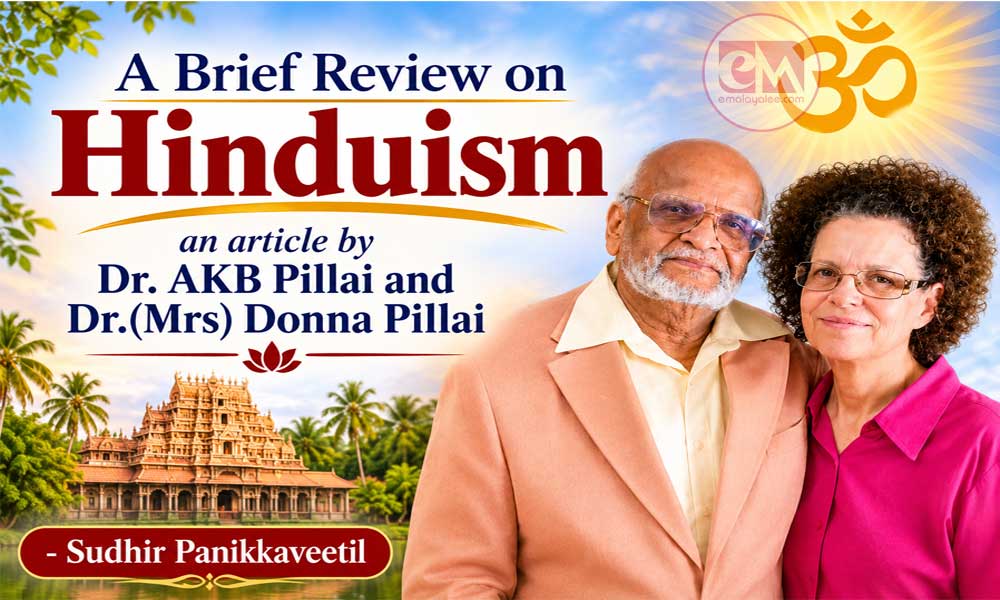
The article on Hinduism by Dr. AKB, a renowned writer, philosopher, teacher, and speaker, provides the reader a clear insight into the details of that religion. Hinduism is the oldest religion in the world, but it has confused people of other faiths who call it more of a way of life than a religion. The abovementioned article will clear most of the doubts and questions of readers about this religion.
Unlike other religions, Hinduism was not created by a single person, nor was it recovered through warfare or weapons. The inhabitants of Indus Valley had developed a culture and civilization, and wise men among them known as Rishis composed Vedas (Veda means knowledge), and later Upanishads were attached to it. A Varna (classification on the basis of the color of people) system was prevalent by virtue of it. Brahmins, the top category in the hierarchy of the caste system had the monopoly of ritualism and learning. The working class were considered outcasts and were brutally treated. There is mention in the article about four castes and the supremacy of Brahmins. Hindus proclaim the oneness of all the people, living beings, and the Godhead known as Advaita.
The Brahnins were the advisors of the kings, and they had enjoyed almost all privileges available to those groups. Dr. Pilllai has explained the caste system in Kerala and informed us that the coconut farmers of the then Kerala were Buddhists who were later pushed out of the mainstream to be known as Ezhavas and classified as other backward communities. He has given descriptions of the order of Sanyasis and mentioned the prominent names among them as Shankaracharya, Sree Narayana Guru, etc. The Sanyasi group is divided into followers of Shiva and Vishnu, and they are still active. The Hindu sanyasis are dedicated to the quest for oneself to identify with Godhead Brahman. We read in this article about Matha Amrutandamai, Aayyppa Swami, etc.
He mentions the Bhagavad Gita and the methods like jnjanya yoga, karma yoga, etc. to gain salvation. While speaking of Yogas, the author mentions a system of meditation he has developed known as Integral Developmental Mediation (IDM) to help stress reduction, calmness, gentleness of behavior, and intellectual growth. We also learn about Tranquility Medicine and creative visualization invented by him, which also help to achieve other benefits for the human body and mind.
In the second part of the article, he is detailing the Sanatana Dharama, which ensures the well-being of all living beings. There are details of deities and states that those who worship the deities in accordance with the rituals devotedly can reach Brahman. In order to live a better life, Hinduism advises fasting, meditation, individual chanting of mantras, etc. The author of the article is well qualified to explain and interpret Hindu customs and scriptures, the Vedas and other books such as Puranas and the Gita, as he is an erudite person. Hence, he could create better methods out of the holy books and scriptures. Accordingly, he has developed spiritual medicine for the well-being of all. There is a brief explanation about the great epics such as the Ramayana, the Mahabharata, and the Bhagavad Gita. He further states about temples, ashrams, and Ayurveda, and there is mention of the unique book of India, the Kama Sutra. He concludes this part by saying that Hinduism emerged from the intellectual discoveries of ascetics in ancient India.
In the third part we understand the various changes that have taken place in Hinduism from time to time. The growth of Buddhism would have wiped out the supremacy of Brahmins, but the aggressive Brahminical movement could bring back its hegemony. Rejection of the caste system and the advent of samajams like Brahma Samaj and Arya Samaj have been briefly narrated. These religious groups wanted to uphold the values of Vedas. They rejected the caste system and considered all human beings as equals. These three articles give a panoramic view of the Hindu system of worship and belief. It also refers to the important books and their contents explained succinctly. These articles will be of interest to readers who wish to acquire knowledge on Hinduism and its practices.
Good wishes to Dr. AKB Pillai and Madam Dr. Donna Pillai.
The End

EMalayalee Available in MediaAppUSA



Copyright © 2024 emalayalee.com - All Rights Reserved.
Webmastered by MIPL, Web Hosting Calicut Kerala