

It goes on indefinitely… (Core of the review: Sudhir Panikkaveetil)
Aachiyamma asks whether “basic reading and arithmetic, which are the beginning of life, are not enough”. If he had not acquired knowledge about the world, she says, her son would have married a woman and lived with her, looking after the land. After completing her studies, Alice too thinks about travelling. To move away from home and from her native place, to find a job, to become independent. Thus, the journeys of people who think in this way continue today, uninterrupted, unbroken, and ceaseless.
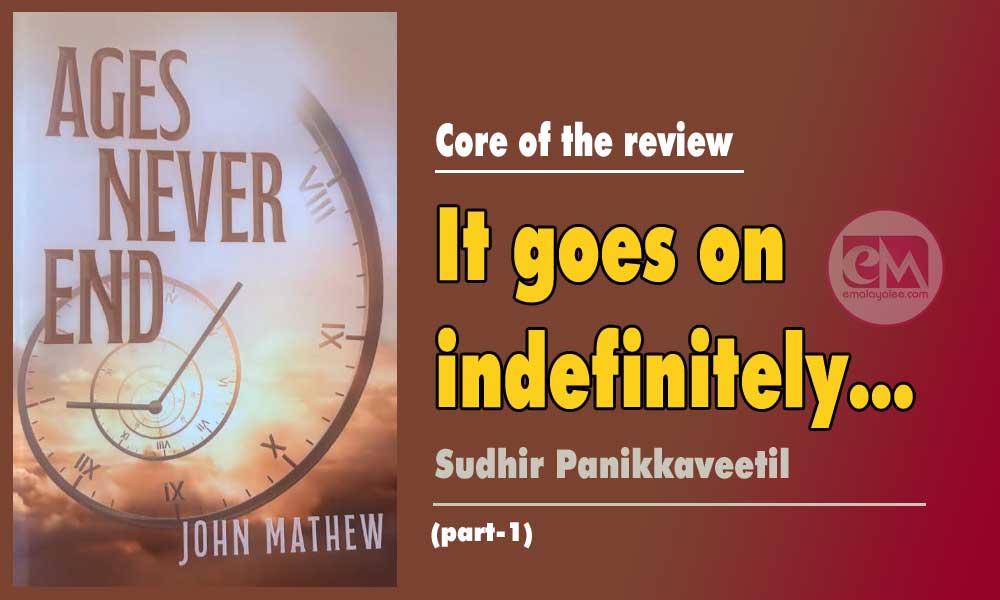
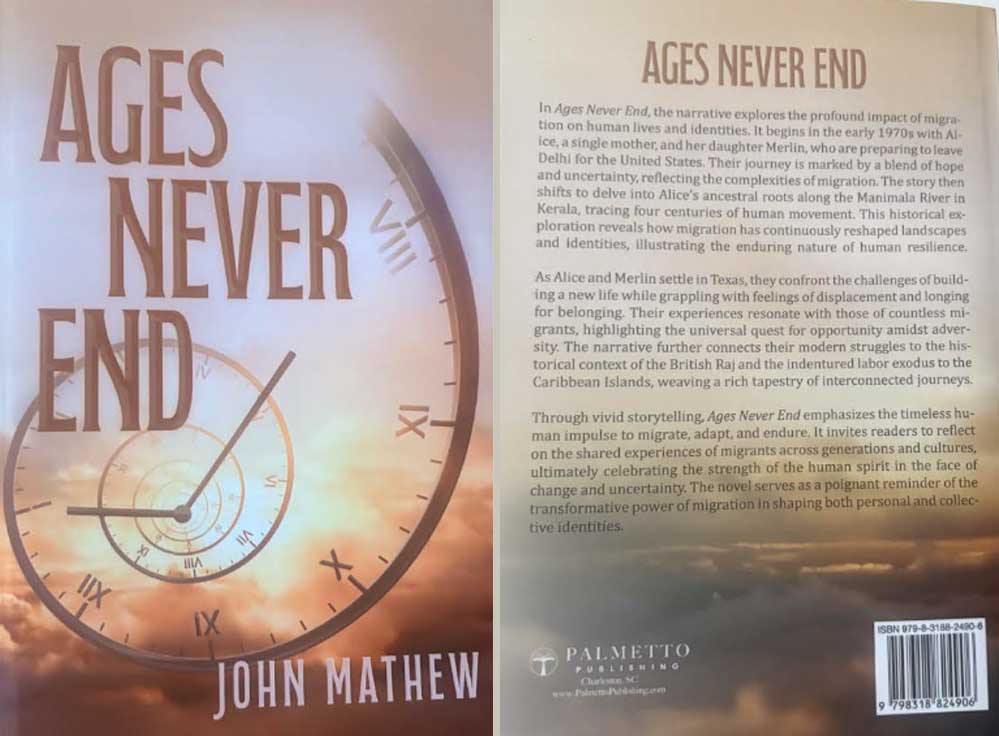
Eras do not come to an end; each era dawns anew. According to Hindu mythology, infinite time is divided into cycles of eras. They are known as the four Yugas. Krita Yuga, Treta Yuga, Dvapara Yuga, and Kali Yuga. Three Yugas have passed, and now the age of Kali is manifesting all the horrors of its completion. The new English novel by the renowned American Malayali writer Mr. John Mathew, titled "Ages Never End," encompasses the four Yugas. Part One: Delhi, Part Two: Manimalayar, Part Three: Karadithodu, Part Four: The Covenant. This monumental novel, spread across five hundred and eighty seven pages, is highly enjoyable to read, and each event described in it arouses our curiosity, draws us into the narrative, and imparts knowledge to us.
The four parts mentioned above are presented as small chapters. Each chapter is a story of its own. That is one of the distinctive features of this novel. Through each story, the novelist moves time forward. In the fourth and final part, titled “The Covenant,” the novelist speaks as an experienced philosopher who has understood the essence of life, or rather, of expatriate life. Although many have recorded that migration has contributed to the growth of human progress, its contributions to the literary sphere are usually ignored. Although the works of expatriate writers have helped the aesthetic development of Malayalam literature, this is not given attention. When expatriate writers portray the experiences of the countries where they live and the diverse lives they encounter there, all of these help broaden the readers’ world.
The interweaving of real events and fiction makes this novel distinctive. The hurdles each migrant has overcome, the changes each country they settled in brought about in their language and culture, and the progress and problems the country they migrated to has achieved and faced are all meticulously documented in this novel. Those living as expatriates may find themselves recognizing the characters in it. The novelist has succeeded in portraying them with such authenticity.
For ages, human beings have been on the move. Life itself is an exile. The novelist himself says so. There is no such thing as exile, the sorrow of exile, nostalgia, or the children of the soil; they are constantly migrating. Nowhere is there an individual called “I”; it is society, the flow of society, and there is no other way but to join it. The information described here substantiates the novelist’s idea that “knowledge is danger”. In fact, knowledge frightens us. We cannot stop it. That fear enters into us. These are not the kinds of knowledge we understand from textbooks. The novelist makes us realize that they have seeped in gradually through the exchanges handed down by our grandmother and through what we have observed. The novelist also reminds us that time will find an end to everything. Through the characters in this novel, the novelist makes one thing clear: exile occurs when human beings acquire knowledge. That is why it is said that knowledge is dangerous. Aachiyamma asks
whether “basic reading and arithmetic, which are the beginning of life, are not enough”. If he had not acquired knowledge about the world, she says, her son would have married a woman and lived with her, looking after the land. After completing her studies, Alice too thinks about travelling. To move away from home and from her native place, to find a job, to become independent. Thus, the journeys of people who think in this way continue today, uninterrupted, unbroken, and ceaseless.
Delhi
Part One - One of the writer's wayside stops. He describes the differences he discovers when he pays attention to the changes between the Delhi he encounters and the Delhi that exists by the time he later leaves the place. Through these descriptions, a person who has never lived in or seen Delhi can understand information about Delhi.
The city of Delhi has changed into the state we see today through continuous changes. The novelist, who moves along with it, experiences this directly. In any society, the changes are brought about by those who migrate and settle there, then the displacement of people caused by wars, and epidemics. When speaking about Pratap Nagar in Delhi, the novelist observes that the place where refugees who migrated from Pakistan due to the Partition of India lived in large numbers became a suburb. As the population increases and businesses, hospitals, and schools fill the area, its old appearance changes. Such losses create new faces of progress. The novelist's observations record historical facts. The novelist also notes the truth that along with the growth of cities, evil too grows in society. He observes that while those who make small buds of cannabis into balls and have them used as drugs make illicit financial gains, it is also eating away at a society. Thus, when the police investigate those who reap such profits, they disappear. He also goes on to describe the deceptions of those who return years later as prominent leaders in politics.
The novelist sees the city as a larger version of the village. It is said that the landlord-tenant relationship seen in the countryside can be found here as well. Small-scale industrialists enabled the lower strata of society, who had calculated time by looking at shadows, to buy clocks. Small traders growing under the shelter of big merchants. In this novel, there is a reference to a Sardarji who comes to a large company carrying a bag. The novelist also finds elements of a dialectical materialist principle in urban development. Many events unfold through the perspective of a Malayali expatriate. One such event is visiting the church on Sundays. The way they find a place for it, and how it then grows and develops into a solution to the spiritual needs of a section of the community, creates a strong sense of realism in the reader. The lines also subtly suggest that expatriates take up literary writing, but society does not view them as seriously as they view literature themselves. The migration of a female character hinted at through a story to America, the land of her dreams, and the fulfillment of that dream are experiences shared by the majority of Malayalis who migrated to Delhi at that time. They represent a community. Each of the stories of events makes it clear that Malayalis preserve their heritage, language, and customs even in the places they arrive in after leaving their own homes in search of a livelihood.
We may assume that this novel is an epic that touches upon and carries forward the lives of people living in different circumstances. We may surmise that this human epic was born when the novelist’s interest in accurately portraying the complexities and uncertainties of human life was combined with his skill in storytelling. Novelists have been described as exceptionally skilled psychologists. They are able to describe the mental processes of all the characters they present with great subtlety. It can be understood that this has been made possible by the novelist’s worldly experience and powers of observation, acquired through his long years of life in exile.
(to be continued)

EMalayalee Available in MediaAppUSA



Copyright © 2024 emalayalee.com - All Rights Reserved.
Webmastered by MIPL, Web Hosting Calicut Kerala