

An Open Letter to Shri. V.V. Rajesh, Mayor of Thiruvananthapuram (George Abraham)
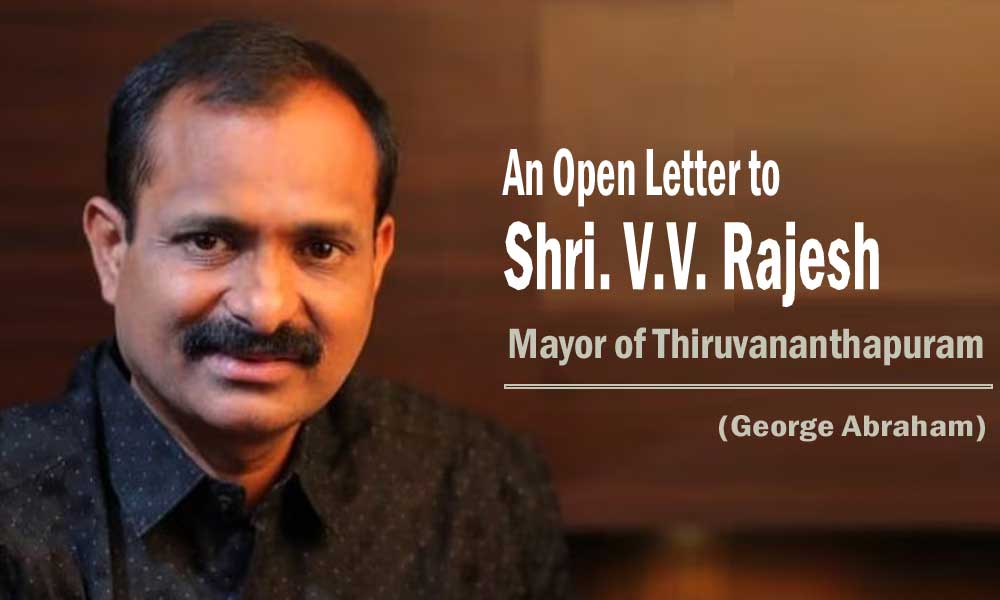
Hon. Mayor V. V. Rajesh,
We Malayalees are truly gratified by your keenness to learn, adapt, and seek inspiration from wherever it may be found. The news of your visit to the United States and subsequent agreements with the Mayor of Missouri City, intended to help Thiruvananthapuram, has been well received back home. Wishing you all success on that front.
In addition, we have learned that you, along with the editor of Janmabhoomi, visited the Guruvayurappan Temple in Houston. We are delighted to hear that no American Nationalists appeared at the temple gates to protest your presence, disrupt the gathering, question your patriotism, or intimidate you for participating in a religious event.
We are equally relieved that American authorities did not rush to investigate whether a foreign visitor, presumably traveling on a visitor’s visa, had addressed a religious gathering, or threatened the temple with regulatory consequences merely for providing you a platform. Apparently, in America, a visiting political leader can enter a place of worship, worship according to his faith, address fellow believers, and leave without having to prove that his religious activity poses no threat to the nation.
Perhaps the fellow Malayalees who so warmly welcomed you did not mention this small privilege called religious freedom. They can build temples, gather for worship, conduct prayers, invite religious and political personalities from India, and publicly practice and propagate their faith without being asked whether their devotion makes them less American. People are free to follow their faith as a matter of conscience. Millions of Americans embrace Hindu beliefs, traditions, spiritual practices, and customs, and their freedom to do so is protected by the same Constitution that protects Christians, Muslims, Jews, Sikhs, Buddhists, atheists, and everyone else.
Therein lies a certain irony worth carrying home. The freedoms we enthusiastically exercise when we are guests in another country ought not to become freedoms we view with suspicion when exercised by minorities in our own. Religious liberty acquires its true meaning only when we are prepared to defend the person praying in a church or mosque with the same enthusiasm with which we demand that freedom for ourselves at a temple.
As I write this, your party is moving forward with amendments to the Foreign Contribution (Regulation) Act (FCRA). The proposed provisions have caused serious concern among minority and charitable organizations that have dedicated generations building schools, colleges, hospitals, orphanages, and other institutions that have served Indians of every religion and social background, including, undoubtedly, many eminent leaders of your own party.
Particularly troubling is the proposed framework regulating assets created through foreign contributions when an organization’s FCRA registration is canceled, surrendered, expires, or is not renewed. Such provisions raise an uncomfortable question: could regulatory action against an organization ultimately become a pathway for institutions and assets built across generations to pass into the hands of a government-appointed authority? A school does not cease educating Indian children because some of the money that built it came from abroad. A hospital does not stop healing Indians because Christians, Hindus, Muslims, or others living overseas helped finance its construction.
Perhaps, therefore, you could use your good offices to convey to our Prime Minister that the freedom you have witnessed and enjoyed in America may itself be worth taking home as part of your study tour. And perhaps your visit might also offer a fresh appreciation of why leaders such as Jawaharlal Nehru and Dr. B.R. Ambedkar studied democratic ideas from around the world while framing the institutions of independent India. They understood that liberty, equality, constitutional government, and freedom of conscience do not become “Western” merely because Western democracies also cherish them. Freedom has no nationality.
I am sorry that I have to write this open letter. Perhaps some of the community leaders who invited you, welcomed you, serenaded you, posed for photographs with you, and enthusiastically published those photographs simply became too busy with the festivities to trouble you with these minor matters of religious freedom and constitutional liberty. So, I thought I would mention them.
Meanwhile, I sincerely wish you every success in implementing the Missouri City agreements. If Thiruvananthapuram can bring home some useful lessons in technology and development from your American visit, perhaps there is room in the suitcase for a little religious freedom as well.
With best wishes,
George Abraham

EMalayalee Available in MediaAppUSA



Copyright © 2024 emalayalee.com - All Rights Reserved.
Webmastered by MIPL, Web Hosting Calicut Kerala